Financing all Credit Types - 
Financing all Credit Types -
Financing all Credit Types -
Financing all Credit Types -
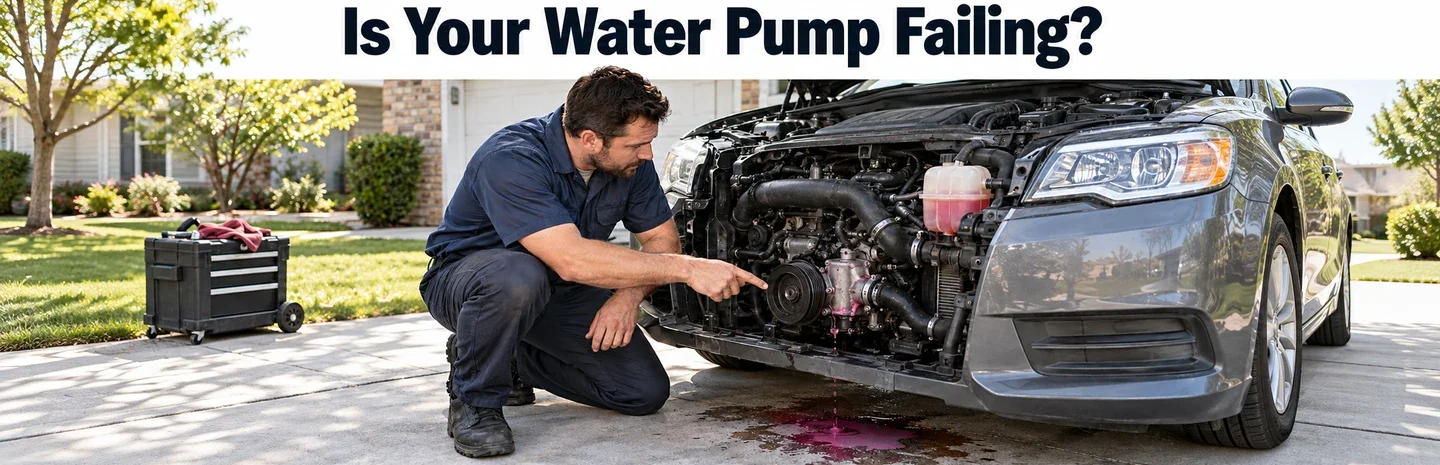
Your water pump has one job: keep coolant moving through the engine so it does not overheat. When it starts to fail, the signs can be easy to miss, because a bad water pump can mimic a bad thermostat, a clogged radiator, or even a head gasket problem. These seven symptoms can indicate a water pump problem or another cooling-system issue, so a proper diagnosis matters before any parts get replaced.
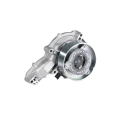
One of the more common signs is a small puddle of coolant under the car, usually pink, green, or orange. On many vehicles the pump sits behind the drive belt at the front of the engine, and most designs have a weep hole on the bottom. When the internal seal wears out, coolant drips from that hole. A few drops after an overnight park is often how it gets noticed. Some vehicles use electric pumps or mount the pump elsewhere, so the leak location can vary. If you are seeing coolant but cannot find the source, our guide on coolant leaks with no visible leak covers the other hiding spots.
A weak pump may not move coolant fast enough, so the temperature gauge climbs higher than normal, especially in traffic or on hills. If your car is overheating in stop-and-go traffic but the gauge drops once you get moving, the radiator fan and airflow through the radiator also need checking, along with the thermostat. We break that pattern down in our article on why a car overheats but the coolant is full.
On belt-driven pumps, the bearing wears out over time, and a high-pitched whine that rises and falls with engine RPM can mean the bearing is on its way out. A rough grinding or rumbling sound can mean it is further along. Not every pump is belt-driven, and noises can travel, so a mechanic can check the pump bearing and pulley for excessive play and confirm where the sound is actually coming from.
Steam from under the hood can mean the engine is overheating or coolant is leaking onto hot engine parts. If you see steam, pull over safely and shut the engine off, and do not remove the radiator or coolant reservoir pressure cap while the engine is hot - the system is pressurized and can cause serious burns. Driving on steam can cause major engine damage, so this is the point where assistance is far cheaper than "just making it home."
If you are topping off the reservoir more often than usual and there is no obvious puddle, a pump seal may be leaking only while the engine runs and the system is pressurized, with coolant evaporating on hot engine parts before it reaches the ground. Other cooling-system leaks can cause the same pattern. Our article on what it means when the coolant reservoir is empty but the radiator is full explains this in more detail.
If the pump is visible on your vehicle, look for crusty white or colored deposits around the weep hole or pulley - a sign coolant may have been seeping for a while. Mixing incompatible coolant types or running straight water can speed up corrosion, and the right long-term fix after repairs can include a coolant flush with the correct fluid. On engines where the pump is buried behind covers, this check has to wait for a mechanic.
This one surprises people. Your cabin heat comes from hot coolant, and weak cabin heat can be a clue that coolant is not circulating the way it should. It is a cooling-system clue that needs diagnosis, not proof of a bad pump - low coolant, air in the system, a stuck thermostat, or a clogged heater core can cause the same symptom.
There is no safe universal answer, because it depends on how the pump is failing and how your engine is behaving. The sensible approach: arrange an inspection promptly. If the engine overheats, loses coolant rapidly, or makes severe mechanical noise, stop safely and arrange assistance. On some vehicles the water pump is driven by the timing belt, so a seized pump can affect the belt as well, which is one more reason not to put the inspection off.
The procedure depends on the pump design and location. It may involve removing drive belts, timing components, or other parts before replacing the pump and refilling and bleeding the system. In many cases an Instant Car Fix mechanic can replace a water pump at your home or office, though it depends on the vehicle and your location. We service most areas nationwide. When Instant Car Fix supplies both the parts and the labor, the repair is backed by our 12-month / 12,000-mile warranty, subject to our terms.
If you are not sure the pump is the problem, book a water pump diagnosis. The mechanic can check for leaks, assess coolant circulation, and perform additional tests as needed before recommending repairs.


There is no single interval - it depends on the vehicle, the pump design, and coolant maintenance. If your water pump is driven by the timing belt, it often makes sense to replace both at the same time, since much of the labor overlaps.
No. A thermostat stuck closed can restrict coolant flow; a bad pump may not move it. Both can cause overheating, which is why a proper diagnosis matters before replacing parts.
The seal can leak only when the system is hot and pressurized. The coolant evaporates on hot engine parts, so you may never see a puddle - just a reservoir that keeps dropping.
In many cases, yes - it depends on the vehicle and your location. Tell us your car and ZIP code when you get a quote and we will confirm availability.
The leak can get worse and the engine can overheat, which risks expensive damage like a warped cylinder head or blown head gasket. Arrange an inspection promptly; if the engine overheats, loses coolant rapidly, or makes severe mechanical noise, stop safely and arrange assistance.
Book an Instant Car Fix mechanic to come to you. We service most areas nationwide.

Dustin did a fantastic job getting my broken bolt out fast and efficiently. I can now continue my project. Thank you!


Although there was some confusion about our appointment window. I found customer service to be extremely helpful. My only suggestion would be that there is the opportunity to chat with the actual mechanic. I was arranging service for my father, who’s out of town and had some memory issues, so it would’ve made it much easier to coordinate and understand if I could chat with the mechanic.

Jelson monterrosa and Adrian gee Did a fantastic job work , quick and efficient , and i'm very happy with the work they did to my vehicle definitely would call them again They were absolutely the best

Somewhat hesitant as it was a website I had never used before, but the mechanic came out. Performed the service, quick and efficient and good to go.

Needed a subframe cradle replaced for a 2014 Dodge Charger 5.7. Left the mechanic this morning. I had to go to work. Got back from work. Checked on my vehicle turned it on, and no more engine vibration inside my cabin. Job well done. Thank you.

Sergio fixed the car really fast and it drives and sounds much better than before. I would recommend having him fix any car again

Mr. Jimmy is great and very good with his work. I would recommend him again to do the work. Thank you!

My mobile mechanic Donny was fantastic. He arrived promptly, diagnosed the issue right away, and replaced my battery quickly and efficiently. He’s extremely knowledgeable and clearly an expert in his field. I really appreciated his professionalism and the smooth experience from start to finish. I would gladly use his services again and highly recommend him to anyone needing reliable mobile auto repair.

Used this site first time and got good results,mechanic came on time ,did all testing and diagnostic,found out our battery not working right.We happy with service.

Dustin did a fantastic job getting my broken bolt out fast and efficiently. I can now continue my project. Thank you!
Although there was some confusion about our appointment window. I found customer service to be extremely helpful. My only suggestion would be that there is the opportunity to chat with the actual mechanic. I was arranging service for my father, who’s out of town and had some memory issues, so it would’ve made it much easier to coordinate and understand if I could chat with the mechanic.
Jelson monterrosa and Adrian gee Did a fantastic job work , quick and efficient , and i'm very happy with the work they did to my vehicle definitely would call them again They were absolutely the best
Somewhat hesitant as it was a website I had never used before, but the mechanic came out. Performed the service, quick and efficient and good to go.
Needed a subframe cradle replaced for a 2014 Dodge Charger 5.7. Left the mechanic this morning. I had to go to work. Got back from work. Checked on my vehicle turned it on, and no more engine vibration inside my cabin. Job well done. Thank you.
Sergio fixed the car really fast and it drives and sounds much better than before. I would recommend having him fix any car again
Mr. Jimmy is great and very good with his work. I would recommend him again to do the work. Thank you!
My mobile mechanic Donny was fantastic. He arrived promptly, diagnosed the issue right away, and replaced my battery quickly and efficiently. He’s extremely knowledgeable and clearly an expert in his field. I really appreciated his professionalism and the smooth experience from start to finish. I would gladly use his services again and highly recommend him to anyone needing reliable mobile auto repair.
Used this site first time and got good results,mechanic came on time ,did all testing and diagnostic,found out our battery not working right.We happy with service.