Financing all Credit Types - 
Financing all Credit Types -
Financing all Credit Types -
Financing all Credit Types -
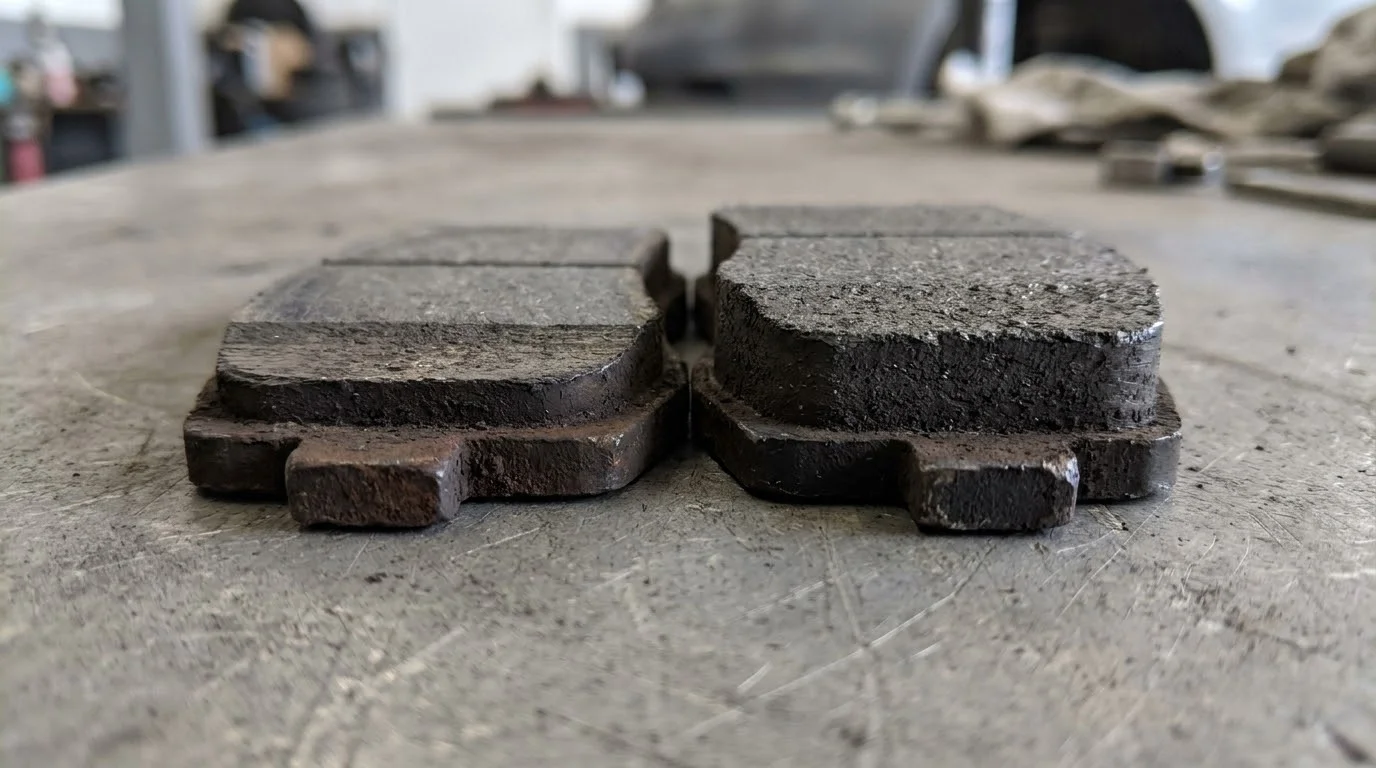
The mechanic shows you two brake pads from the same wheel. One has plenty of friction material left; the other is much thinner. It is reasonable to ask why, especially if someone is recommending another set of pads sooner than you expected.
The short answer is that the pads may not be applying, moving or releasing as intended. A sticking caliper component, a pad binding in its bracket or another brake-system fault can leave one pad doing more work. But the wear pattern helps guide the inspection; it does not identify the failed component by itself. First establish which pads are being compared.
Each disc brake has a pad on either side of its rotor. Comparing the inner and outer pad at one wheel asks a different question from comparing the left and right wheel or the front and rear axle. Front and rear brakes do not necessarily perform equal work, and brake designs vary.
Ask the technician to record the wheel position and the measured friction-material thickness for each pad. A statement such as "the brakes are uneven" is less useful than identifying the affected corner and whether the difference is across the rotor, across an axle or across the length of one pad.
Do not include the metal backing plate in a friction-material comparison. A photograph can document the pattern, but a camera angle or a view through wheel spokes cannot replace access and measurement. The outer pad can look acceptable while the inner pad is difficult to see.
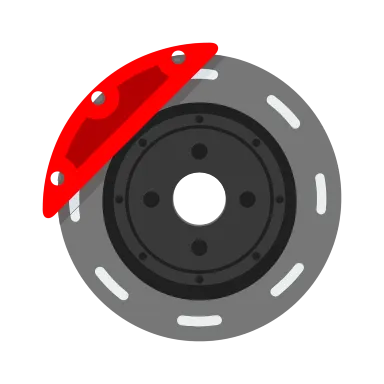
On a floating-caliper design, slide movement and piston operation both matter. Wagner explains that excessive outer-pad wear can point to seized slides, while excessive inner-pad wear can involve a piston that does not release properly. Those are directions for testing, not a universal rule that identifies a single failed part.
The technician examines the brake caliper, guide pins, boots, pad supports and hardware as appropriate to the design. A pad that cannot move freely in its bracket is a different finding from a damaged piston or an issue keeping hydraulic pressure applied. The estimate should connect the recommended repair to the confirmed finding.
Tapered wear means the friction material is thinner at one end or edge. Slide problems, clearance, fitment or caliper condition can affect contact with the rotor. Ferodo also notes an important exception: some pads are tapered by design. Compare the actual part and vehicle specification before calling every taper a defect.
Scoring, contamination, cracking or heat damage add information. A groove in the friction surface is not the same pattern as one whole pad being thinner. Ask whether the rotor surface and thickness were checked and whether the installed parts are correct for the vehicle. New pads cannot correct an unresolved contact or fitment problem.
After correcting the cause, pads are normally replaced as a complete axle set: both front wheels or both rear wheels. Brake pad replacement should not leave a binding slide or damaged support unchanged. Otherwise, the new material can develop the same abnormal wear.
That does not mean every uneven pad requires a new caliper and rotor. Some findings call for service of permitted moving parts or hardware; others require component replacement. Rotor condition and service limits are checked rather than guessed from how many pad changes it has seen. Ask which parts failed inspection and which remain serviceable.
Request a clear record: the affected wheel, inner and outer measurements, the wear pattern, the condition of the rotor, and the cause found during the inspection. If the brakes were recently serviced, tell the technician when the work occurred and provide the invoice if available. Recent work is relevant history, not proof of blame.
Ask how the proposed work corrects the cause and how the technician will verify release and braking operation afterward. If a full assembly is recommended, ask why servicing a separately repairable part is unsuitable. If only pads are recommended, ask what explains the uneven wear and whether that cause has been corrected.
Wear measurements and symptoms both matter. Pulling, smoke, a burning odor, grinding, a changed pedal or reduced stopping ability need prompt attention. If braking is impaired, keep the vehicle parked and arrange inspection or transport. Do not touch a wheel or brake assembly to compare heat, and do not drive around to reproduce the problem.
Even without those symptoms, visible uneven wear deserves a brake inspection. The useful outcome is more specific than "new brakes": measured wear, a confirmed cause, an explained repair and checks that the system operates correctly afterward.


A piston or release problem is one possibility, particularly on a floating-caliper system. Pad movement, hardware and other faults also need checking. The thinner inner pad guides inspection; it does not prove the caliper must be replaced.
Yes. Restricted slide movement can keep the pads from applying or releasing as intended. The technician checks the pins, boots, bracket and related parts and follows the service instructions for that design.
They can wear at different rates because the axles have different braking duties and may use different designs. That is not the same comparison as a large inner-to-outer difference at one wheel.
That view can reveal some concerns but may hide the inner pad and parts of the rotor. It cannot establish that all pads are serviceable or explain a wear difference. Proper access and measurement are needed.
No. Pad binding, hardware, fitment, rotor condition and other brake-system faults can contribute. The repair recommendation should identify the confirmed cause, not rely on a single photograph.
The technician selects the required pad set and related work using the vehicle specification and condition of the brakes. Replacing one pad without correcting abnormal wear is not an adequate plan.
Ask for wheel position, inner and outer friction-material thickness, rotor findings and any taper or damage. Also ask what caused the pattern and how the proposed work corrects it.
Arrange an inspection for uneven brake wear before choosing replacement parts.

Great service! I appreciate how clear Jean Carlos explained everything and even let me know what other areas of my Jeep needed attention. I also appreciated Instant Fix following up with me to schedule my next service. 10/10 would definitely recommend


Mr. Jimmy is great and very good with his work. I would recommend him again to do the work. Thank you!

Dustin did a fantastic job getting my broken bolt out fast and efficiently. I can now continue my project. Thank you!

Although there was some confusion about our appointment window. I found customer service to be extremely helpful. My only suggestion would be that there is the opportunity to chat with the actual mechanic. I was arranging service for my father, who’s out of town and had some memory issues, so it would’ve made it much easier to coordinate and understand if I could chat with the mechanic.

Somewhat hesitant as it was a website I had never used before, but the mechanic came out. Performed the service, quick and efficient and good to go.

Was very helpful and went out of his way to run multiple Diagnostics to find the issue, got the job done very fast and put me back on the road.

Sergio fixed the car really fast and it drives and sounds much better than before. I would recommend having him fix any car again

These guys show up and do great work. I've had a couple issues with my vehicle and Instant Car Fix helped me fully diagnose and repair all issues with relative ease. Great customer service and great communication. Thanks guys!

Needed a subframe cradle replaced for a 2014 Dodge Charger 5.7. Left the mechanic this morning. I had to go to work. Got back from work. Checked on my vehicle turned it on, and no more engine vibration inside my cabin. Job well done. Thank you.

Great service! I appreciate how clear Jean Carlos explained everything and even let me know what other areas of my Jeep needed attention. I also appreciated Instant Fix following up with me to schedule my next service. 10/10 would definitely recommend
Mr. Jimmy is great and very good with his work. I would recommend him again to do the work. Thank you!
Dustin did a fantastic job getting my broken bolt out fast and efficiently. I can now continue my project. Thank you!
Although there was some confusion about our appointment window. I found customer service to be extremely helpful. My only suggestion would be that there is the opportunity to chat with the actual mechanic. I was arranging service for my father, who’s out of town and had some memory issues, so it would’ve made it much easier to coordinate and understand if I could chat with the mechanic.
Somewhat hesitant as it was a website I had never used before, but the mechanic came out. Performed the service, quick and efficient and good to go.
Was very helpful and went out of his way to run multiple Diagnostics to find the issue, got the job done very fast and put me back on the road.
Sergio fixed the car really fast and it drives and sounds much better than before. I would recommend having him fix any car again
These guys show up and do great work. I've had a couple issues with my vehicle and Instant Car Fix helped me fully diagnose and repair all issues with relative ease. Great customer service and great communication. Thanks guys!
Needed a subframe cradle replaced for a 2014 Dodge Charger 5.7. Left the mechanic this morning. I had to go to work. Got back from work. Checked on my vehicle turned it on, and no more engine vibration inside my cabin. Job well done. Thank you.