Financing all Credit Types - 
Financing all Credit Types -
Financing all Credit Types -
Financing all Credit Types -
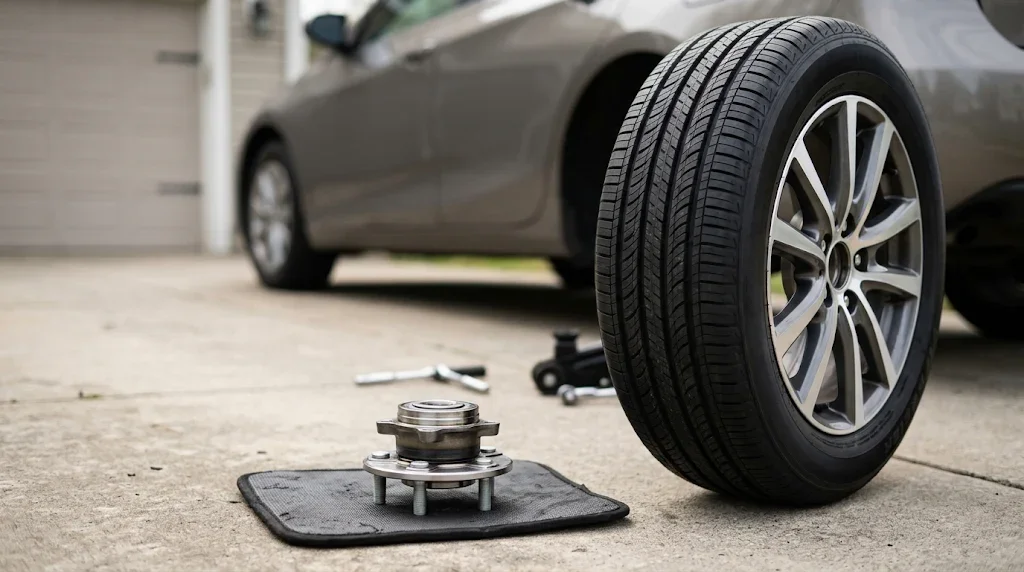
A low drone that rises as the car gathers speed can make a wheel bearing seem like the obvious suspect. Uneven tire tread can produce a similar sound. So can problems elsewhere around the wheel. An online recording may sound familiar, but an inspection still needs to locate the noise.
The distinction matters because the repairs address different problems. A new bearing will not smooth out cupped tread, and new tires will not repair a damaged bearing. Ask what the inspection actually established.
A wheel bearing supports rotation at the hub. Damage at its rolling surfaces can create noise as the wheel turns. Tires also generate sound as their tread meets the road, and irregular wear can change that sound into a hum, rumble, or roar.
Both rotate faster when road speed increases. That is why "it gets louder on the highway" does not separate them. Pitch, volume, and where you seem to hear the sound are useful descriptions, not enough evidence to select a part or a corner of the car.
The wheel bearing service page explains the repair itself. Before that decision, the noise needs to be traced rather than named from the driver's seat.
Give the mechanic a short description of what you have already noticed during ordinary driving:
A change on different pavement makes tire and road interaction worth investigating. A noise that changes during a bend also needs interpretation before selecting a repair.
Do not weave across a lane, drive faster, or repeat hard turns to test a theory. Report the existing pattern and let the technician decide whether a controlled road test is appropriate.
Scalloped or cupped tread has alternating high and low areas. Feathered tread has uneven edges across the tread blocks. Such patterns can contribute to noise and call for checks of tire condition, balance, alignment, and suspension as appropriate.
Look only at tread and sidewall areas visible beside the safely parked car. Leave lifting, rotating wheels, and close inspection of hidden surfaces to someone equipped to do that work. A bulge, exposed cord, or other visible damage deserves attention even if it does not explain the original hum.
Correcting alignment or balance does not restore rubber already worn away. A mechanic considering tire replacement should explain both the tire's condition and any cause that needs correction. Otherwise, a noisy wear pattern may remain after an adjustment, or develop again on another tire.
A bearing can be noisy without obvious movement in a basic wheel check. It may also behave differently carrying the vehicle's weight than when spun unloaded. A quiet hand-spin or a wheel that feels tight does not, by itself, settle the complaint.
A technician may need to isolate the hub from brake contact, compare rotating components, or measure movement using the procedure for that vehicle. The allowable movement and inspection method depend on the bearing arrangement. One internet clearance number is not a rule for every hub.
Ask what finding links the noise to the bearing: localized roughness, abnormal movement, or other evidence from the prescribed checks. If the result remains uncertain, further car noise diagnosis is more useful than replacing the best guess.
Brake contact can produce a scraping or rotational noise. Clicking during turns can lead the inspection toward a CV axle, while wheel imbalance and tire damage can accompany steering wheel shaking. These are reasons to inspect those systems, not automatic diagnoses.
If the complaint includes more than sound, describe the sensation separately. Our guide to a car that shakes while driving covers that wider distinction. A car can have a tire problem and a bearing problem at the same time; finding one does not automatically exclude the other.
Before approving work, ask which wheel is affected, what was found there, and whether the tires and brakes were checked as alternative sources. If a tire rotation is proposed to help isolate noise, it must suit the vehicle's tire sizes, direction requirements, and tire condition.
Stop in a safe place and seek assistance for severe wobbling, unstable steering, reduced braking, smoke from a wheel area, or a visibly damaged tire. Do not touch hot hubs or brakes. For a new unexplained hum, arrange an assessment rather than treating the absence of those signs as permission to keep driving.


Compare the reported noise pattern with tire condition and wheel-end inspection findings. Road-surface changes and tread wear can support a tire-related explanation, but neither clears the bearing.
Do not assume an unexplained wheel noise is safe. Describe it to the mechanic before moving the car and ask whether transport is needed. Severe wobble, steering trouble, reduced braking, or smoke calls for stopping safely and arranging assistance.
Irregular tire tread, brake contact, and drivetrain faults can resemble a bearing complaint. A sound described as humming, grinding, or clicking needs its operating conditions and source checked.
The work depends on the hub design, access, fastening condition, and required equipment. Some repairs use a bolt-on assembly; others involve pressing a bearing. The estimate should identify the arrangement and the work required for your vehicle.
There is no dependable remaining-distance estimate from noise alone. Loudness or time since the sound began cannot establish a failure stage. An inspection is needed to assess the fault and decide how the vehicle should be moved.
There is no fixed first wheel that applies to every vehicle. Loading, impacts, contamination, installation, and use vary. The repair should follow findings at the affected wheel, not an assumption based on front, rear, left, or right.
Book an Instant Car Fix mechanic to come to you. We service most areas nationwide.

Although there was some confusion about our appointment window. I found customer service to be extremely helpful. My only suggestion would be that there is the opportunity to chat with the actual mechanic. I was arranging service for my father, who’s out of town and had some memory issues, so it would’ve made it much easier to coordinate and understand if I could chat with the mechanic.


Mr. Jimmy is great and very good with his work. I would recommend him again to do the work. Thank you!

Used this site first time and got good results,mechanic came on time ,did all testing and diagnostic,found out our battery not working right.We happy with service.

Jelson monterrosa and Adrian gee Did a fantastic job work , quick and efficient , and i'm very happy with the work they did to my vehicle definitely would call them again They were absolutely the best

Sergio fixed the car really fast and it drives and sounds much better than before. I would recommend having him fix any car again

Needed a subframe cradle replaced for a 2014 Dodge Charger 5.7. Left the mechanic this morning. I had to go to work. Got back from work. Checked on my vehicle turned it on, and no more engine vibration inside my cabin. Job well done. Thank you.

My mobile mechanic Donny was fantastic. He arrived promptly, diagnosed the issue right away, and replaced my battery quickly and efficiently. He’s extremely knowledgeable and clearly an expert in his field. I really appreciated his professionalism and the smooth experience from start to finish. I would gladly use his services again and highly recommend him to anyone needing reliable mobile auto repair.

Dustin did a fantastic job getting my broken bolt out fast and efficiently. I can now continue my project. Thank you!

Somewhat hesitant as it was a website I had never used before, but the mechanic came out. Performed the service, quick and efficient and good to go.

Although there was some confusion about our appointment window. I found customer service to be extremely helpful. My only suggestion would be that there is the opportunity to chat with the actual mechanic. I was arranging service for my father, who’s out of town and had some memory issues, so it would’ve made it much easier to coordinate and understand if I could chat with the mechanic.
Mr. Jimmy is great and very good with his work. I would recommend him again to do the work. Thank you!
Used this site first time and got good results,mechanic came on time ,did all testing and diagnostic,found out our battery not working right.We happy with service.
Jelson monterrosa and Adrian gee Did a fantastic job work , quick and efficient , and i'm very happy with the work they did to my vehicle definitely would call them again They were absolutely the best
Sergio fixed the car really fast and it drives and sounds much better than before. I would recommend having him fix any car again
Needed a subframe cradle replaced for a 2014 Dodge Charger 5.7. Left the mechanic this morning. I had to go to work. Got back from work. Checked on my vehicle turned it on, and no more engine vibration inside my cabin. Job well done. Thank you.
My mobile mechanic Donny was fantastic. He arrived promptly, diagnosed the issue right away, and replaced my battery quickly and efficiently. He’s extremely knowledgeable and clearly an expert in his field. I really appreciated his professionalism and the smooth experience from start to finish. I would gladly use his services again and highly recommend him to anyone needing reliable mobile auto repair.
Dustin did a fantastic job getting my broken bolt out fast and efficiently. I can now continue my project. Thank you!
Somewhat hesitant as it was a website I had never used before, but the mechanic came out. Performed the service, quick and efficient and good to go.