Financing all Credit Types - 
Financing all Credit Types -
Financing all Credit Types -
Financing all Credit Types -
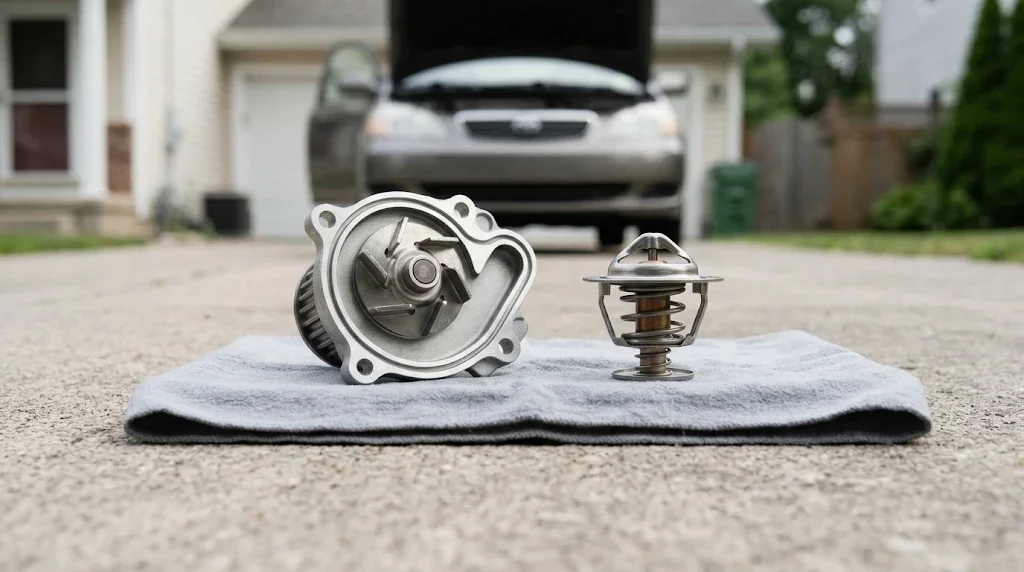
Your temperature gauge climbs, and two possible repairs come up: a water pump or a thermostat. Both affect coolant movement, but they do different jobs. Choosing between them from the gauge alone can mean replacing a working part while the overheating problem remains.
Bad water pump symptoms can overlap with thermostat trouble, low coolant, restricted radiator flow, and fan problems. The useful distinction is not simply when the car gets hot. It is what the inspection shows about coolant loss, pump operation, and how the engine regulates temperature.
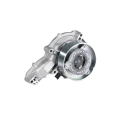
The pump moves coolant through the cooling circuit. The thermostat controls its route through the radiator as the engine warms up. They work together, so a problem with either can interfere with heat removal.
A thermostat that does not open properly can restrict radiator circulation. One that stays open can delay engine warm-up. A pump can lose its ability to circulate coolant because of an impeller, drive, or electrical problem. It can also develop a seal leak or bearing damage.
The layout matters. Some pumps are belt-driven; others are electric and operate under electronic control. A diagnosis should start with the system fitted to your engine, not a test copied from another vehicle.
An active leak traced to the pump's seal or housing is more specific evidence than a puddle beneath the engine. Coolant can travel along nearby surfaces before dripping, and a hose or thermostat housing may be the actual source.
Dry residue needs context too. Manufacturer guidance can distinguish old or temporary traces from an active pump leak. A stain alone is not a universal replacement rule. Tell the mechanic whether the coolant level keeps dropping and whether the area was recently serviced.
A rumble or squeal may warrant checking a mechanical pump's bearing and drive, but adjacent pulleys and belt components can sound similar. Arrange an inspection promptly. The sound alone cannot establish how close a component is to failure.
Our water pump service guide covers replacement considerations once the failed component has been identified.
An engine that takes unusually long to reach operating temperature can point toward a thermostat staying open. The temperature reading itself also needs checking. A faulty sensor or display can misrepresent what the engine is doing.
Overheating on the highway does not prove the pump is bad, and overheating in traffic does not clear it. Those patterns help plan checks of airflow, coolant level, circulation, and control. They are not dependable shortcuts for naming a failed part.
Changes in cabin heat are worth reporting, particularly alongside temperature changes or coolant loss. Heater performance also depends on heater-core flow and air-control components, so cold air from the vents cannot settle the pump-versus-thermostat question.
Ask the mechanic what evidence supports the proposed repair. A useful inspection may include:
A pressure test can help find a leak, but it does not by itself prove that the pump moves coolant correctly or that the thermostat opens. Our cooling-system pressure-test guide explains that part of the investigation.
For an electric pump, an electrical fault and a mechanically damaged pump are different possibilities. Diagnostic information and the manufacturer's procedures help determine which checks apply. Not every internal fault can be confirmed without disassembly.
For an overheating warning, steam, or substantial coolant loss, pull over safely, switch off the engine, and arrange assistance. Do not keep driving to see whether the gauge drops. If steam is escaping, stay clear and do not open the hood until it has stopped.
Never remove a radiator or coolant-reservoir pressure cap while the system is hot. Keep hands and clothing away from belts and fans, which can operate unexpectedly. Do not use an open-cap running-engine experiment to judge coolant flow.
Ask whether the estimate addresses a confirmed fault or an untested possibility. If both parts are recommended, ask why each is included: a failed test, manufacturer guidance, or access shared with other necessary work.
Afterward, the system needs the specified coolant and filling or bleeding procedure. Verification should address the original complaint, leaks, and operating temperature. A new pump or thermostat is not the end of the diagnosis if the original symptom remains.


The outcome depends on the failure. A leaking seal can reduce coolant level; an impeller or drive fault can impair circulation. Either can lead to overheating and engine damage. There is no dependable sequence of warning signs or safe driving distance to count on.
The checks depend on its design and the complaint. They can include tracing leakage, inspecting the drive and bearing, and evaluating circulation or electrical operation. The findings need to be considered alongside thermostat function and the rest of the cooling system.
Yes. Internal impeller damage or an electrical problem can affect pumping without leaving an external puddle. That is why an absence of visible coolant leakage cannot rule out the pump, even though it helps narrow the inspection.
Possible causes include seal or bearing damage, coolant contamination, corrosion, drive-belt problems, and electrical faults in electric water pumps. Which applies depends on the design and findings. Correcting a contributing problem matters when installing the replacement.
The pump moves coolant; the thermostat controls its route through the radiator. A mechanic checks for pump leakage, drive or electrical problems, and whether the thermostat opens as specified. Overheating alone cannot identify which part is faulty, and another cooling-system problem may be responsible.
Yes. A thermostat that stays closed or does not open sufficiently can limit coolant circulation through the radiator without an external leak. The absence of a puddle does not confirm that diagnosis. Pump operation, radiator flow, coolant level, and fan function still need consideration.
Book an Instant Car Fix mechanic to come to you. We service most areas nationwide.

Jelson monterrosa and Adrian gee Did a fantastic job work , quick and efficient , and i'm very happy with the work they did to my vehicle definitely would call them again They were absolutely the best


Needed a subframe cradle replaced for a 2014 Dodge Charger 5.7. Left the mechanic this morning. I had to go to work. Got back from work. Checked on my vehicle turned it on, and no more engine vibration inside my cabin. Job well done. Thank you.

Mr. Jimmy is great and very good with his work. I would recommend him again to do the work. Thank you!

Dustin did a fantastic job getting my broken bolt out fast and efficiently. I can now continue my project. Thank you!

Although there was some confusion about our appointment window. I found customer service to be extremely helpful. My only suggestion would be that there is the opportunity to chat with the actual mechanic. I was arranging service for my father, who’s out of town and had some memory issues, so it would’ve made it much easier to coordinate and understand if I could chat with the mechanic.

My mobile mechanic Donny was fantastic. He arrived promptly, diagnosed the issue right away, and replaced my battery quickly and efficiently. He’s extremely knowledgeable and clearly an expert in his field. I really appreciated his professionalism and the smooth experience from start to finish. I would gladly use his services again and highly recommend him to anyone needing reliable mobile auto repair.

Sergio fixed the car really fast and it drives and sounds much better than before. I would recommend having him fix any car again

Used this site first time and got good results,mechanic came on time ,did all testing and diagnostic,found out our battery not working right.We happy with service.

Somewhat hesitant as it was a website I had never used before, but the mechanic came out. Performed the service, quick and efficient and good to go.

Jelson monterrosa and Adrian gee Did a fantastic job work , quick and efficient , and i'm very happy with the work they did to my vehicle definitely would call them again They were absolutely the best
Needed a subframe cradle replaced for a 2014 Dodge Charger 5.7. Left the mechanic this morning. I had to go to work. Got back from work. Checked on my vehicle turned it on, and no more engine vibration inside my cabin. Job well done. Thank you.
Mr. Jimmy is great and very good with his work. I would recommend him again to do the work. Thank you!
Dustin did a fantastic job getting my broken bolt out fast and efficiently. I can now continue my project. Thank you!
Although there was some confusion about our appointment window. I found customer service to be extremely helpful. My only suggestion would be that there is the opportunity to chat with the actual mechanic. I was arranging service for my father, who’s out of town and had some memory issues, so it would’ve made it much easier to coordinate and understand if I could chat with the mechanic.
My mobile mechanic Donny was fantastic. He arrived promptly, diagnosed the issue right away, and replaced my battery quickly and efficiently. He’s extremely knowledgeable and clearly an expert in his field. I really appreciated his professionalism and the smooth experience from start to finish. I would gladly use his services again and highly recommend him to anyone needing reliable mobile auto repair.
Sergio fixed the car really fast and it drives and sounds much better than before. I would recommend having him fix any car again
Used this site first time and got good results,mechanic came on time ,did all testing and diagnostic,found out our battery not working right.We happy with service.
Somewhat hesitant as it was a website I had never used before, but the mechanic came out. Performed the service, quick and efficient and good to go.