Financing all Credit Types - 
Financing all Credit Types -
Financing all Credit Types -
Financing all Credit Types -
Your mechanic mentions a canister. A parts listing says purge valve. Someone else tells you to check the vent solenoid. It's easy to think they're three names for the same thing. They aren't, and replacing one won't necessarily fix a fault in another.
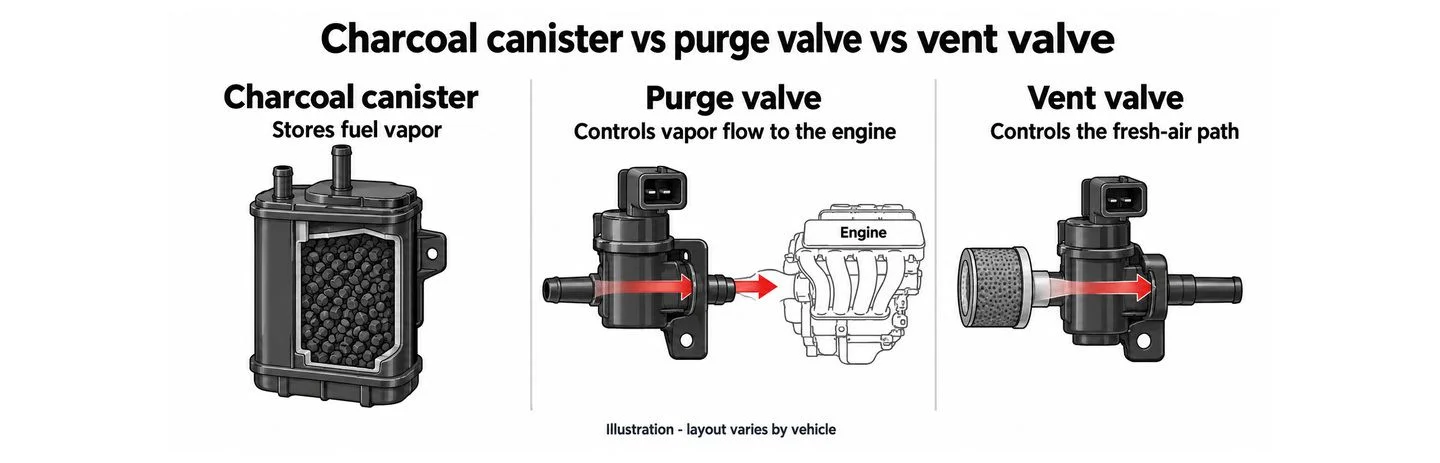
All three belong to the evaporative emissions control system, usually called EVAP. They work together to keep gasoline vapor from escaping into the air. The simplest way to remember the difference is this: the charcoal canister stores vapor, the purge valve controls its path into the engine, and the vent valve manages the system's fresh-air path.
Those are common arrangements, not a parts diagram for every car. Some vehicles combine components or use different leak-detection hardware. The vehicle's repair information determines what is fitted and how it should be tested.
Gasoline gives off vapor even while the car is parked. The charcoal canister holds that vapor instead of letting it escape. When conditions are right, the system draws the stored vapor into the engine to be burned.
The canister is a storage component, not simply an on-off switch. A cracked housing, contamination or restricted flow can cause problems. Repeatedly adding fuel after the nozzle clicks off can send liquid fuel into a system designed to manage vapor. Stop at the normal automatic shutoff rather than trying to squeeze in more.
The purge valve is the controlled connection between the canister and the engine intake. The engine computer commands vapor flow when operating conditions allow it. On many vehicles, the valve sits in the engine compartment, but the exact location varies.
A valve that leaks when it should be closed can allow unwanted vapor or air into the intake. That can contribute to rough running or hard starting, including trouble after refueling. Those symptoms still need testing: they aren't proof that the purge valve is the failed part.
If starting trouble happens specifically after a fuel stop, our guide to a car that won't start after getting gas covers that narrower situation.
The vent side lets filtered fresh air move through the system as needed. In a common design, the vent valve closes when the car checks whether the EVAP system is sealed. Some vehicles have the valve close to, or integrated with, the canister.
A blocked vent path can make refueling difficult. You might find the pump repeatedly shutting off before the tank is full. A valve that won't seal can also interfere with an EVAP self-test. Neither symptom proves that the entire canister needs replacing; the valve, filter, hoses and electrical controls may need separate checks.
A check engine light tells you the car detected a problem, not which part to buy. An EVAP leak code can involve a cap, hose, seal, valve or another component. A circuit code may instead lead the mechanic toward a connector, wiring or electrical control problem.
Diagnosis may include reading codes and vehicle data, checking the system's plumbing and connections, testing valve operation and using an appropriate leak test. The test should match the vehicle's design. Swapping the purge valve, vent valve and canister in turn can get expensive without finding the cause.
There isn't a universal safe number of miles or days. First, make sure the faulty part has actually been identified. A steady check engine light with otherwise normal operation is a different situation from a car that stalls, runs badly or smells strongly of raw gasoline.
If you suspect a fuel leak, see liquid fuel or notice a strong persistent gasoline smell, stop using the vehicle and arrange professional help. Repeated stalling or a flashing check engine light also calls for prompt assessment rather than trying to finish the trip. Don't assume an emissions-related code makes every symptom harmless.
Even when the car feels normal, arrange diagnosis rather than ignoring the warning. EVAP faults can affect emissions testing where it applies. A mechanic can advise on the next step from the actual symptoms, codes and test results, not from the name of a part alone.
You don't need to know every EVAP component to ask those questions. A clear explanation should connect the symptom to a confirmed fault, then explain why that repair fits.
Tell Instant Car Fix what you've noticed: a warning light, rough idle, difficult refueling or trouble starting. Include any trouble codes you have. Request a quote to check diagnosis and mobile appointment options for your vehicle and location. Availability and the work that can be completed on-site depend on the vehicle and the fault.


No. The purge valve controls vapor flow toward the engine. The vent valve controls the fresh-air path and helps seal the EVAP system for testing. They have different jobs, even though both belong to the same system.
You may see canister purge valve, EVAP purge valve, purge solenoid or canister purge solenoid. Catalog wording varies, so match the part to your vehicle and the diagnosed fault rather than the name alone.
Possible signs include a check engine light or a fuel pump that repeatedly clicks off before the tank is full. A valve that won't seal can also interfere with the EVAP self-test. A blocked hose, filter or electrical fault can cause similar problems, so those symptoms don't confirm the valve needs replacing.
There is no blanket safe-to-drive answer. A steady warning light with normal running is different from a suspected fuel leak or repeated stalling. Arrange diagnosis. Do not keep driving with a suspected leak, strong persistent gasoline smell, repeated stalling or a flashing check engine light.
There is no universal safe mileage or time limit. First confirm the faulty part: a canister, purge valve and vent valve are not interchangeable diagnoses. Have the vehicle assessed and decide the next step from its symptoms and test results, not a distance estimate.
Not automatically. Both have a job in the EVAP system, but needing one does not prove the other has failed. Testing should identify the fault and check for related contamination or restrictions. Replace the parts the diagnosis supports, using the manufacturer's repair requirements.
It can trigger a check engine light. A valve leaking when it should be closed can also contribute to rough idle, hard starting after refueling or stalling. The symptoms depend on how it fails, and other faults can cause them too. A code or symptom alone isn't enough to identify the failed part.
No. The canister stores fuel vapor in activated charcoal. The purge valve controls when vapor moves from that storage toward the engine. A part listing that says "canister purge valve" usually means the valve, not the charcoal canister itself. Confirm fitment for your vehicle.
Request a quote for diagnosis and mobile appointment options for your vehicle and location.

Dustin did a fantastic job getting my broken bolt out fast and efficiently. I can now continue my project. Thank you!


My mobile mechanic Donny was fantastic. He arrived promptly, diagnosed the issue right away, and replaced my battery quickly and efficiently. He’s extremely knowledgeable and clearly an expert in his field. I really appreciated his professionalism and the smooth experience from start to finish. I would gladly use his services again and highly recommend him to anyone needing reliable mobile auto repair.

Jelson monterrosa and Adrian gee Did a fantastic job work , quick and efficient , and i'm very happy with the work they did to my vehicle definitely would call them again They were absolutely the best

Sergio fixed the car really fast and it drives and sounds much better than before. I would recommend having him fix any car again

Used this site first time and got good results,mechanic came on time ,did all testing and diagnostic,found out our battery not working right.We happy with service.

Needed a subframe cradle replaced for a 2014 Dodge Charger 5.7. Left the mechanic this morning. I had to go to work. Got back from work. Checked on my vehicle turned it on, and no more engine vibration inside my cabin. Job well done. Thank you.

Mr. Jimmy is great and very good with his work. I would recommend him again to do the work. Thank you!

Although there was some confusion about our appointment window. I found customer service to be extremely helpful. My only suggestion would be that there is the opportunity to chat with the actual mechanic. I was arranging service for my father, who’s out of town and had some memory issues, so it would’ve made it much easier to coordinate and understand if I could chat with the mechanic.

Somewhat hesitant as it was a website I had never used before, but the mechanic came out. Performed the service, quick and efficient and good to go.

Dustin did a fantastic job getting my broken bolt out fast and efficiently. I can now continue my project. Thank you!
My mobile mechanic Donny was fantastic. He arrived promptly, diagnosed the issue right away, and replaced my battery quickly and efficiently. He’s extremely knowledgeable and clearly an expert in his field. I really appreciated his professionalism and the smooth experience from start to finish. I would gladly use his services again and highly recommend him to anyone needing reliable mobile auto repair.
Jelson monterrosa and Adrian gee Did a fantastic job work , quick and efficient , and i'm very happy with the work they did to my vehicle definitely would call them again They were absolutely the best
Sergio fixed the car really fast and it drives and sounds much better than before. I would recommend having him fix any car again
Used this site first time and got good results,mechanic came on time ,did all testing and diagnostic,found out our battery not working right.We happy with service.
Needed a subframe cradle replaced for a 2014 Dodge Charger 5.7. Left the mechanic this morning. I had to go to work. Got back from work. Checked on my vehicle turned it on, and no more engine vibration inside my cabin. Job well done. Thank you.
Mr. Jimmy is great and very good with his work. I would recommend him again to do the work. Thank you!
Although there was some confusion about our appointment window. I found customer service to be extremely helpful. My only suggestion would be that there is the opportunity to chat with the actual mechanic. I was arranging service for my father, who’s out of town and had some memory issues, so it would’ve made it much easier to coordinate and understand if I could chat with the mechanic.
Somewhat hesitant as it was a website I had never used before, but the mechanic came out. Performed the service, quick and efficient and good to go.