Financing all Credit Types - 
Financing all Credit Types -
Financing all Credit Types -
Financing all Credit Types -
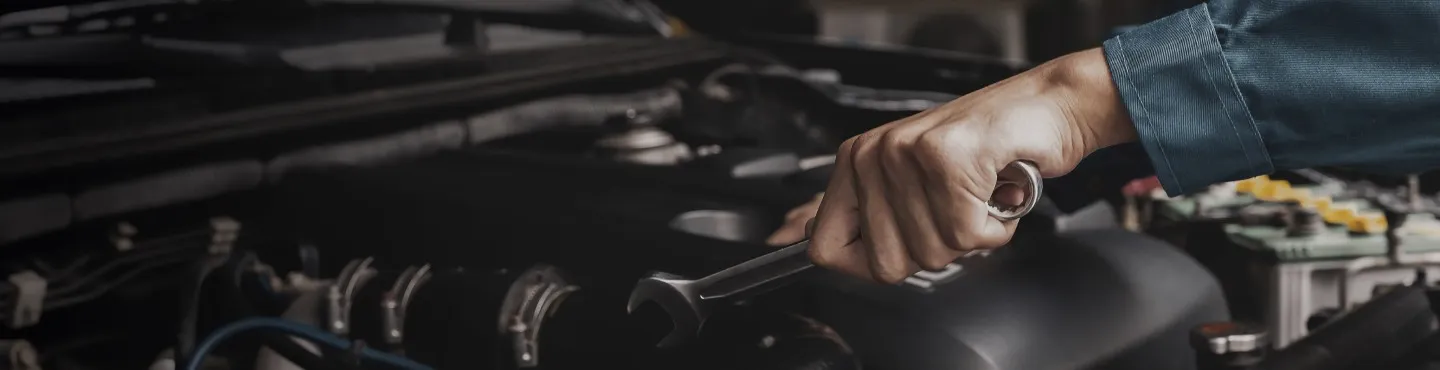
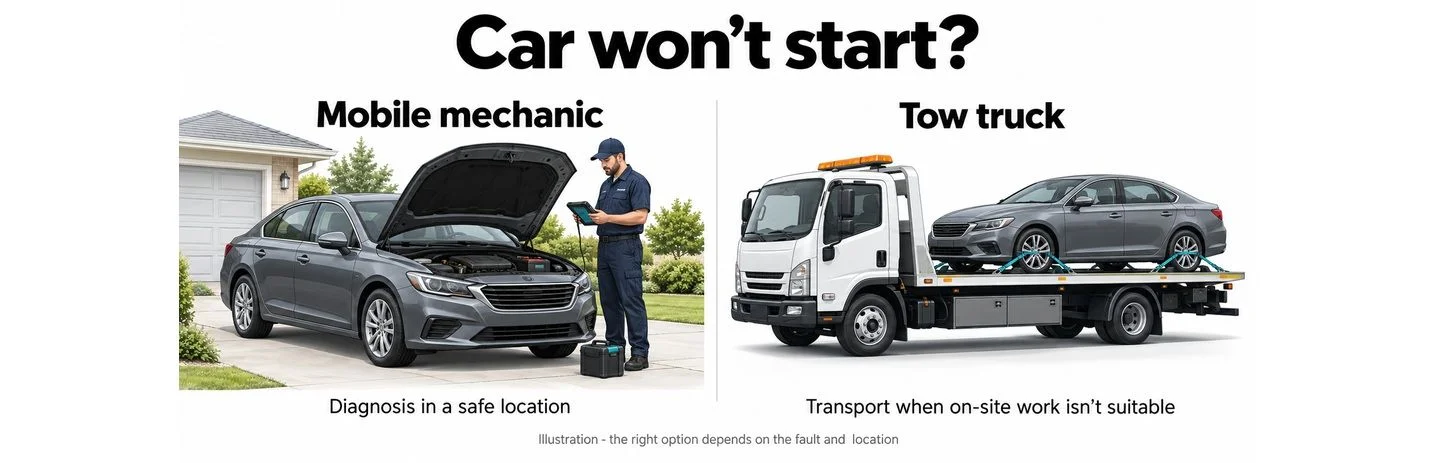
Your car won't start, and you need to get it repaired. But how do you get a car to a mechanic when it won't start?
You have two main options: have a mobile mechanic come to your vehicle or have your car towed to a repair shop.
Many no-start problems, including battery, starter, alternator, and fuel-delivery issues, can be diagnosed where the vehicle is parked. Some can also be repaired on-site. Other problems require specialized shop equipment or a safer working environment.
The right choice depends on what's wrong with your vehicle, where it's parked, and whether it can be repaired safely without towing.
Before calling a mechanic or tow truck, make sure you and your passengers are safe.
If your engine stops while you're driving, turn on your hazard lights and carefully move toward a safe location, such as a shoulder or parking lot, if possible.
Remember that steering and braking assistance may be reduced when the engine stops. You may need additional effort to control the vehicle.
Once safely stopped, set the parking brake and keep your hazard lights on.
Call emergency services if:
Your vehicle catches fire or you see smoke.
You suspect a serious fuel leak or smell fuel and cannot safely determine the source.
Your vehicle is stranded in an active traffic lane or another dangerous location.
If you see fire or smoke, evacuate the vehicle and move a safe distance away. If you smell fuel, stop the engine, avoid restarting it, and move away from the vehicle.
When stranded in a dangerous location, follow emergency dispatchers' instructions about whether to remain inside or exit the vehicle.
Once you're safe, identify your exact location. A nearby intersection, highway exit, mile marker, or GPS pin can help a mechanic or towing company find you.
If your vehicle is parked safely, a few basic observations may help identify the problem.
Pay attention to the sound.
No sound: The problem may involve the battery, electrical system, or starting circuit.
A single click: A starter or electrical problem may be involved.
Rapid clicking: Low battery voltage or an electrical connection problem is possible.
Engine cranks but won't start: The problem may involve fuel delivery, ignition, engine management, or another system.
These symptoms provide clues, but they do not establish a diagnosis.
Dim dashboard lights may indicate a weak battery or an electrical connection problem.
If the lights appear normal, the battery still cannot be ruled out without testing.
For vehicles with automatic transmissions, make sure the gear selector is fully in Park.
If your owner's manual permits it, you can also try starting the vehicle in Neutral.
Check the fuel gauge. If the reading appears questionable, tell the mechanic.
A vehicle can sometimes have a fuel-level indication problem, so the gauge alone may not establish how much fuel remains.
If the symptoms suggest a weak battery, a jump start may be appropriate.
However, consult your owner's manual first. Hybrid and electric vehicles may have specific jump-starting requirements.
Do not attempt a jump start if the battery is visibly damaged, leaking, or frozen, or if you are unsure about the correct procedure.
Avoid repeated, prolonged starting attempts, which can overheat the starter or worsen certain problems.
If these checks don't resolve the issue, a professional diagnosis is the next step.
For additional guidance, read our car won't start troubleshooting guide.
A vehicle that starts after a jump or several attempts is not necessarily safe to drive.
Before considering driving, check for obvious warning signs:
Red oil-pressure or engine-temperature warning lights
Unusual knocking, grinding, or burning smells
Abnormal steering or braking
Engine overheating
Battery or charging-system warning lights
An engine that runs roughly or stalls again
These observations cannot establish that the vehicle is safe.
For example, if the alternator is not charging properly, the vehicle may start after a jump but stop again once the battery loses power.
If you don't know why your vehicle failed to start, have a qualified roadside professional assess it before deciding whether to drive.
A mobile mechanic can travel directly to your vehicle, whether it's parked at home, at work, or in another location where repairs can be performed safely.
Instead of arranging transportation to a repair shop, you can have the vehicle inspected where it sits.
Depending on the vehicle and working conditions, mobile mechanics commonly provide:
Battery testing and replacement
Starter replacement
Alternator replacement
Fuel-system diagnosis and certain fuel-pump repairs
Sensor replacement
Ignition-system repairs
Belt and hose replacement
Brake repairs
Computer diagnostics
Not every repair can be completed on-site.
Some vehicles require specialized equipment, additional parts, or repairs that are better performed in a workshop.
For major transmission problems, internal engine damage, or other extensive repairs, towing to a repair facility may be necessary.
When on-site service is appropriate, a mobile mechanic can offer several advantages.
No unnecessary towing: You may be able to avoid transporting your vehicle to a repair shop.
Convenience: The mechanic comes to your vehicle rather than requiring you to arrange a ride or wait at a repair facility.
On-site diagnosis: The mechanic can inspect the vehicle where the problem occurred.
Potentially faster next steps: If the necessary repair can be performed on-site and the required parts are available, the vehicle may not need to be transported elsewhere.
A mobile mechanic should explain the diagnosis and whether the repair can reasonably be completed at your location.
Need help with a car that won't start? Get a mobile mechanic quote from Instant Car Fix.
Towing is the better choice when a vehicle cannot be inspected or repaired safely at its current location, or when the required work needs shop equipment.
You should consider towing when:
The vehicle has been involved in an accident.
There is visible structural damage.
The vehicle may have serious internal engine or transmission damage.
The car is stranded somewhere unsafe for roadside repair.
A trusted repair facility needs to perform specialized work.
When requesting a tow, provide:
Your exact pickup location
The vehicle's make, model, and year
Whether the vehicle starts, rolls, or can be shifted into Neutral
The destination address
Any special towing requirements
The towing company needs to know whether the vehicle can move under its own power.
Some vehicles require specific loading procedures or equipment.
A flatbed tow truck is often appropriate, but the correct towing method depends on the vehicle. Check your owner's manual and confirm that the towing company can follow the manufacturer's instructions.
Towing charges commonly include a hookup or base fee and a mileage-based charge.
The final cost can depend on:
Distance to the repair shop
Vehicle type
Location
Time of day
Required equipment
Additional recovery or loading services
Request the total estimated charge before dispatch.
Also check whether your auto insurance or roadside assistance membership includes towing coverage.
AAA memberships and some insurance policies provide towing benefits, but coverage limits and conditions vary.
When your car won't start, choosing between a mobile mechanic and a tow truck depends on your vehicle's condition, the repair required, and the total cost.
A mobile mechanic may be the more convenient option when your vehicle is parked somewhere safe and the problem can be diagnosed or repaired on-site.
Advantages of a mobile mechanic:
No towing required: The mechanic travels directly to your vehicle, potentially eliminating towing expenses.
Convenient diagnosis: Your car can be inspected at home, at work, or another suitable location.
Common repairs: Many battery, starter, alternator, sensor, and electrical problems can be handled on-site.
Less transportation hassle: You may not need to arrange a ride to and from a repair shop.
Direct service: If the repair can be completed on-site and the necessary parts are available, you may avoid transporting the vehicle elsewhere.
However, mobile repairs are not suitable for every mechanical problem. Some repairs require specialized equipment or a workshop environment.
Towing is generally the better choice when the vehicle cannot be repaired safely at its current location or requires specialized shop equipment.
Reasons to choose towing:
The vehicle has accident-related or structural damage.
The engine or transmission may require major internal repairs.
The vehicle is stranded in an unsafe location.
The necessary repair cannot reasonably be completed on-site.
You prefer to have the vehicle inspected at a particular repair facility.
Remember that towing charges are generally separate from the repair shop's diagnostic and repair fees.
There is no universal answer.
A mobile mechanic may save you the expense of towing, but diagnostic services, replacement parts, labor, and applicable service fees still affect the total cost.
Towing may be necessary for more extensive repairs, but it adds transportation expenses before the repair shop begins its work.
The best approach is to compare the total estimated cost of both options and choose the service appropriate for your vehicle.
If your vehicle is parked safely and simply won't start, consider requesting a mobile diagnostic quote before arranging a tow.
If your car won't start, use these four questions to determine your next step.
Arrange towing to an appropriate repair facility.
A repair shop may be better equipped to investigate and repair the problem.
Prioritize your safety and arrange professional roadside assistance or towing.
Consider requesting a mobile diagnostic quote before paying to have it transported to a shop.
A mobile mechanic may be able to diagnose the issue and determine whether the necessary repair can be performed on-site.
When your car won't start, getting help shouldn't automatically mean arranging a tow truck.
Instant Car Fix provides mobile auto repair and diagnostic services across the United States.
Our mobile mechanic network can assist with many common no-start problems, including battery, starter, alternator, fuel-system, and electrical issues.
Depending on your vehicle, location, and the repair required, a mechanic may be able to diagnose and repair the problem where your car is parked.
If the vehicle requires specialized shop equipment or cannot be safely repaired on-site, additional repair arrangements may be necessary.
Appointment availability, including expedited service, depends on your location, mechanic availability, and other scheduling factors.
Request a quote and provide your vehicle information, location, and a description of the problem.
Our team can help determine the next available service option.
Get a Free Quote from Instant Car Fix
Or call 844-669-6324.
Requesting a quote is free. Diagnostic services and repairs may involve separate charges.
When your car won't start, you don't always need to have it towed to a repair shop.
A mobile mechanic may be able to diagnose and repair the problem where your vehicle is parked, helping you avoid unnecessary transportation.
However, towing remains the appropriate choice for unsafe locations, accident damage, and repairs requiring specialized shop equipment.
The best approach is to make sure you're safe, perform a few basic checks, and choose the repair option that fits your vehicle's condition.


Yes. Contact a towing company and provide the pickup location, repair shop address, and vehicle information.
Tell the dispatcher that your vehicle won't start so the company can arrange appropriate loading equipment.
If you have roadside assistance coverage, check your benefits before paying for towing.
It depends on the problem.
A mobile mechanic may help you avoid towing charges, but diagnosis and repairs still have associated costs.
Towing adds a transportation expense, and the repair shop may charge separately for diagnosis and repairs.
Compare the complete estimated costs for both options.
Often, yes.
Mobile mechanics can diagnose many common starting problems involving batteries, starters, alternators, fuel delivery, and electrical systems.
Some repairs can be completed on-site, while others require specialized shop equipment.
A diagnosis helps determine the appropriate next step.
Not necessarily.
A car that starts after a jump or repeated attempts may still have an unresolved mechanical or electrical problem.
If the engine stalls again, warning lights remain illuminated, or steering or braking feels abnormal, avoid driving.
Have the vehicle professionally assessed before deciding whether it is safe to operate.
Towing costs depend on distance, location, equipment requirements, and the towing company.
Charges commonly include a base or hookup fee plus mileage.
Ask for a complete quote before dispatch and check whether your roadside assistance plan covers the service.
Have the following information ready:
Your exact location
Vehicle make, model, and year
What happens when you attempt to start the vehicle
Any warning lights, clicking sounds, or unusual symptoms
Whether the vehicle is parked somewhere safe
Providing accurate information can help the service provider determine what assistance and equipment may be needed.
Skip the unnecessary tow. Instant Car Fix brings mobile diagnostic and repair services to your location. Whether it's a battery, starter, alternator, or another issue, our team can help you find the right solution. Request a free quote today. Service availability varies by location. Diagnostic services are billed separately.

Sergio fixed the car really fast and it drives and sounds much better than before. I would recommend having him fix any car again


Somewhat hesitant as it was a website I had never used before, but the mechanic came out. Performed the service, quick and efficient and good to go.

Great service! I appreciate how clear Jean Carlos explained everything and even let me know what other areas of my Jeep needed attention. I also appreciated Instant Fix following up with me to schedule my next service. 10/10 would definitely recommend

Mr. Jimmy is great and very good with his work. I would recommend him again to do the work. Thank you!

These guys show up and do great work. I've had a couple issues with my vehicle and Instant Car Fix helped me fully diagnose and repair all issues with relative ease. Great customer service and great communication. Thanks guys!

Dustin did a fantastic job getting my broken bolt out fast and efficiently. I can now continue my project. Thank you!

Although there was some confusion about our appointment window. I found customer service to be extremely helpful. My only suggestion would be that there is the opportunity to chat with the actual mechanic. I was arranging service for my father, who’s out of town and had some memory issues, so it would’ve made it much easier to coordinate and understand if I could chat with the mechanic.

Needed a subframe cradle replaced for a 2014 Dodge Charger 5.7. Left the mechanic this morning. I had to go to work. Got back from work. Checked on my vehicle turned it on, and no more engine vibration inside my cabin. Job well done. Thank you.

Was very helpful and went out of his way to run multiple Diagnostics to find the issue, got the job done very fast and put me back on the road.

Sergio fixed the car really fast and it drives and sounds much better than before. I would recommend having him fix any car again
Somewhat hesitant as it was a website I had never used before, but the mechanic came out. Performed the service, quick and efficient and good to go.
Great service! I appreciate how clear Jean Carlos explained everything and even let me know what other areas of my Jeep needed attention. I also appreciated Instant Fix following up with me to schedule my next service. 10/10 would definitely recommend
Mr. Jimmy is great and very good with his work. I would recommend him again to do the work. Thank you!
These guys show up and do great work. I've had a couple issues with my vehicle and Instant Car Fix helped me fully diagnose and repair all issues with relative ease. Great customer service and great communication. Thanks guys!
Dustin did a fantastic job getting my broken bolt out fast and efficiently. I can now continue my project. Thank you!
Although there was some confusion about our appointment window. I found customer service to be extremely helpful. My only suggestion would be that there is the opportunity to chat with the actual mechanic. I was arranging service for my father, who’s out of town and had some memory issues, so it would’ve made it much easier to coordinate and understand if I could chat with the mechanic.
Needed a subframe cradle replaced for a 2014 Dodge Charger 5.7. Left the mechanic this morning. I had to go to work. Got back from work. Checked on my vehicle turned it on, and no more engine vibration inside my cabin. Job well done. Thank you.
Was very helpful and went out of his way to run multiple Diagnostics to find the issue, got the job done very fast and put me back on the road.