Financing all Credit Types - 
Financing all Credit Types -
Financing all Credit Types -
Financing all Credit Types -
A repair form asks for your engine size, and the choices look almost identical: 2.0L, 2.5L, turbocharged, hybrid. Your car's model badge may not settle which one belongs on the request. Vehicles with the same model name and year can have different engines.
You do not need to remove engine covers or recognize parts by sight. Start with the vehicle identification number, check available labels or factory records, and flag anything that does not agree. Accurate identification helps match the repair request to the vehicle, but it does not diagnose the fault.
Locate the vehicle identification number, or VIN. On many cars it is visible through the windshield at the driver's side of the dashboard. It may also appear on a door-jamb label, insurance documents or the title. Copy it carefully, or take a clear photograph while the vehicle is safely parked.
Use the full VIN rather than trying to interpret one character from a generic chart. Engine coding needs the correct manufacturer and model-year information. A character that identifies one engine in one application is not a universal engine-size code.
Enter the VIN into NHTSA's VIN decoder. Review the returned vehicle description and available engine fields, including displacement in liters, cylinders, engine model and fuel type. Read any decoding warnings. If a field is blank or the result is uncertain, leave that detail unresolved rather than filling it from another car's listing.
NHTSA notes that its decoded information is reported by manufacturers. For missing or conflicting details, contact the manufacturer or ask the repair provider to confirm the application.
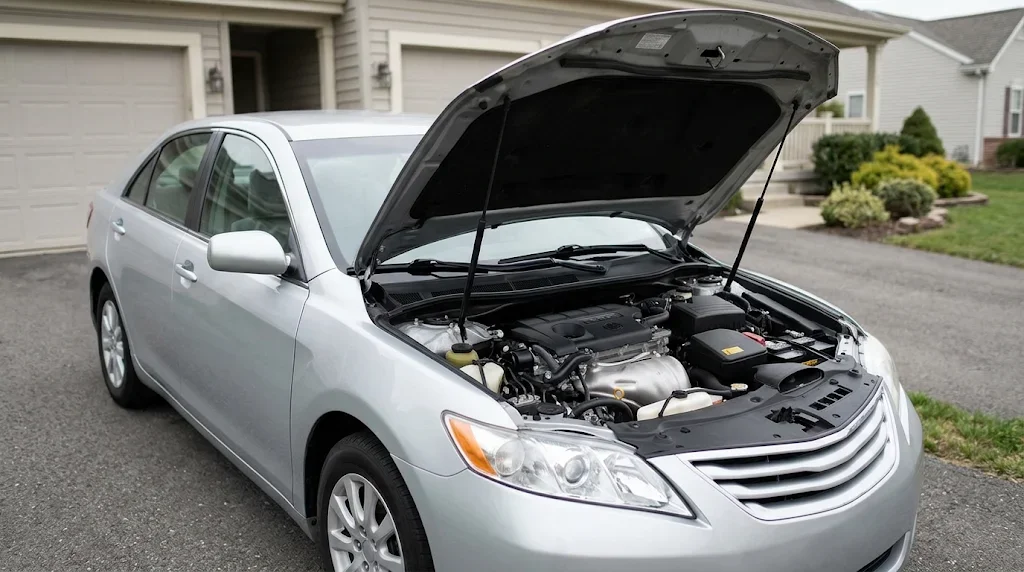
If it is safe to open the hood, switch the vehicle off, let hot components cool and follow the owner's manual. Look without reaching near belts, fans or high-voltage equipment. There is no need to disconnect anything or run the engine for this check.
The federal FuelEconomy.gov guide explains that the underhood emissions label, also called the Vehicle Emission Control Information label, includes engine displacement and an engine-family identifier. Engine size is normally shown in liters.
Photograph the whole readable label, not just one number. An engine-family identifier is different from a simple displacement such as 2.0L. If the label is missing, damaged or unreadable, do not scrape around the engine looking for another marking. Use records or get help identifying it.
An original window sticker or manufacturer build record can help establish the factory engine. Ford's engine-size guidance, for example, points owners to the window sticker, a build sheet or customer support with the VIN available. Other manufacturers may offer different routes.
A general brochure or owner's manual may describe several available engines. Finding a 2.5L specification in that book does not prove your car has that engine. The record needs to match your vehicle, not merely its model name.
Keep useful records together: a VIN photograph, the emissions label and any engine-replacement invoice. If documents disagree, send both versions and explain the discrepancy.
The number followed by "L" describes displacement, not the amount of engine oil to add. Cylinder count is another detail: "four-cylinder" does not identify one particular displacement or engine design.
Fuel type, turbocharging and hybrid configuration can also matter. Two engines described as 2.0L need not use the same parts or repair procedure. Avoid treating a trim badge, engine-cover lettering or an online advertisement as the complete identification.
This matters for work such as spark plug replacement or ignition coil service, where the engine application and access affect the work. Identifying the engine is separate from deciding which component needs replacement.
Provide the year, make, model and full VIN through the repair provider's normal quote channel. Include the engine details you have confirmed, your ZIP code, and the requested work or symptoms. If the form offers no matching engine, ask for help rather than selecting the nearest option.
Describe a symptom in plain language: when it happens, any warning lights, and recent repairs. A request for general diagnostics is different from requesting a named replacement part. Engine identification helps the provider understand the vehicle; testing establishes the fault.
Mention a known engine replacement or modification. A VIN lookup describes factory information, so it cannot by itself verify what is currently installed in a modified vehicle. An invoice or further inspection may be needed before parts are selected.
Keep identification photos focused on the relevant information. You do not need to post a title, insurance card or other personal paperwork in a public comment to ask an engine-size question.


Start with a VIN lookup, then compare available emissions-label or factory-record information. If the sources disagree or a result is incomplete, have the manufacturer or repair provider confirm the engine before selecting parts.
A VIN decoder can return factory engine information, including displacement where available. Check the complete result and any warnings. Missing fields and a replacement engine are reasons to seek confirmation rather than assume the lookup settles everything.
Look for the displacement on the emissions label or a vehicle-specific factory record, and compare it with the VIN result. Do not decide from the model name alone. Send the label photograph if you need help reading it.
It describes the engine's nominal displacement: the combined volume swept by its pistons. It is not the oil capacity, fuel-tank capacity or cylinder count. Use the manufacturer's specified fluid capacities for maintenance.
Engine size is relative. For a repair quote, the exact engine and configuration matter more than whether it is considered large or small.
A VIN lookup alone cannot establish that. Replacement invoices, service records and inspection of the installed engine can help investigate a mismatch. Tell the repair provider about any known replacement before parts are ordered.
Share your vehicle details and the work or symptoms you want assessed. If the engine information is uncertain, tell us rather than selecting a guess.

Somewhat hesitant as it was a website I had never used before, but the mechanic came out. Performed the service, quick and efficient and good to go.


Needed a subframe cradle replaced for a 2014 Dodge Charger 5.7. Left the mechanic this morning. I had to go to work. Got back from work. Checked on my vehicle turned it on, and no more engine vibration inside my cabin. Job well done. Thank you.

My mobile mechanic Donny was fantastic. He arrived promptly, diagnosed the issue right away, and replaced my battery quickly and efficiently. He’s extremely knowledgeable and clearly an expert in his field. I really appreciated his professionalism and the smooth experience from start to finish. I would gladly use his services again and highly recommend him to anyone needing reliable mobile auto repair.

Dustin did a fantastic job getting my broken bolt out fast and efficiently. I can now continue my project. Thank you!

Although there was some confusion about our appointment window. I found customer service to be extremely helpful. My only suggestion would be that there is the opportunity to chat with the actual mechanic. I was arranging service for my father, who’s out of town and had some memory issues, so it would’ve made it much easier to coordinate and understand if I could chat with the mechanic.

Jelson monterrosa and Adrian gee Did a fantastic job work , quick and efficient , and i'm very happy with the work they did to my vehicle definitely would call them again They were absolutely the best

Mr. Jimmy is great and very good with his work. I would recommend him again to do the work. Thank you!

Sergio fixed the car really fast and it drives and sounds much better than before. I would recommend having him fix any car again

Used this site first time and got good results,mechanic came on time ,did all testing and diagnostic,found out our battery not working right.We happy with service.

Somewhat hesitant as it was a website I had never used before, but the mechanic came out. Performed the service, quick and efficient and good to go.
Needed a subframe cradle replaced for a 2014 Dodge Charger 5.7. Left the mechanic this morning. I had to go to work. Got back from work. Checked on my vehicle turned it on, and no more engine vibration inside my cabin. Job well done. Thank you.
My mobile mechanic Donny was fantastic. He arrived promptly, diagnosed the issue right away, and replaced my battery quickly and efficiently. He’s extremely knowledgeable and clearly an expert in his field. I really appreciated his professionalism and the smooth experience from start to finish. I would gladly use his services again and highly recommend him to anyone needing reliable mobile auto repair.
Dustin did a fantastic job getting my broken bolt out fast and efficiently. I can now continue my project. Thank you!
Although there was some confusion about our appointment window. I found customer service to be extremely helpful. My only suggestion would be that there is the opportunity to chat with the actual mechanic. I was arranging service for my father, who’s out of town and had some memory issues, so it would’ve made it much easier to coordinate and understand if I could chat with the mechanic.
Jelson monterrosa and Adrian gee Did a fantastic job work , quick and efficient , and i'm very happy with the work they did to my vehicle definitely would call them again They were absolutely the best
Mr. Jimmy is great and very good with his work. I would recommend him again to do the work. Thank you!
Sergio fixed the car really fast and it drives and sounds much better than before. I would recommend having him fix any car again
Used this site first time and got good results,mechanic came on time ,did all testing and diagnostic,found out our battery not working right.We happy with service.