Financing all Credit Types - 
Financing all Credit Types -
Financing all Credit Types -
Financing all Credit Types -
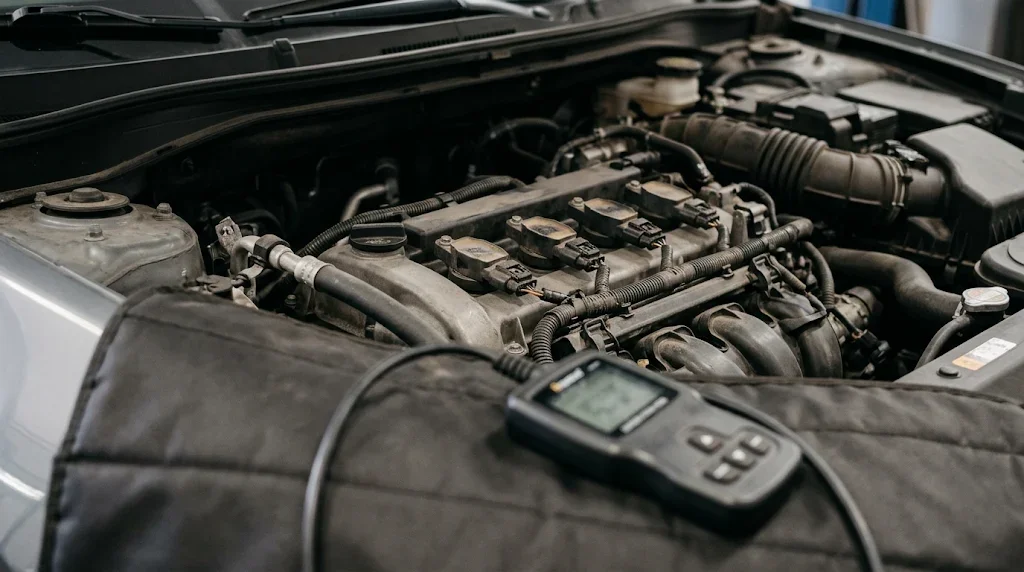
A scanner names an ignition coil, and the next step seems obvious: replace that coil. But a trouble code records a condition the vehicle's computer detected, not a completed diagnosis. The coil may be faulty, or the problem may be in the wiring, connector, power supply, or control circuit serving it.
That distinction matters when a replacement fails to clear the fault. Before approving another part, ask what the code actually means for your engine and what evidence identifies the failed component.
P0351 generally describes an ignition coil A primary/secondary circuit fault. The exact definition, circuit layout, and coil identification must come from service information for your vehicle. Do not assume coil A is whichever coil is easiest to reach. Some engines use individual coils; others use a coil pack that serves multiple cylinders.
P0301 identifies a detected misfire in cylinder 1. It does not specify an ignition coil as the cause. Spark plugs, fuel delivery, air leaks, and mechanical problems can also produce misfires. P0300 describes random or multiple-cylinder misfires rather than naming one cylinder.
A circuit code and a misfire code can appear together. They give the mechanic different clues: one concerns the monitored ignition circuit; the other concerns how the cylinder is firing.
A diagnostic inspection should preserve the stored codes and available freeze-frame data before anything is cleared. That snapshot can help connect the fault to operating conditions such as engine speed, load, or temperature.
The mechanic then checks the relevant connector, harness, and coil area. Corrosion, damaged insulation, a loose terminal, oil contamination, or water in a plug well may explain why the circuit is unreliable. Battery condition and the coil's electrical supply also matter. A fault affecting several coils can call for checks of shared circuits rather than replacing every coil separately.
The ignition coil still needs evaluation, but seeing its name on a scanner does not prove it needs replacement.
The test sequence depends on the ignition design and manufacturer instructions. A technician may measure supply voltage and circuit integrity, inspect the spark plug and boot, and examine control signals with suitable equipment. There is no single resistance reading that proves every type of coil is healthy.
Where compatible individual coils can safely be interchanged, a controlled swap may help determine whether a misfire follows a component. A swap test can help investigate a misfire, but it does not replace circuit testing for a P0351 fault. A damaged connector can be disturbed during removal, and some faults appear only under particular conditions.
If wiring and coil tests do not explain the result, the control module and its driver circuit may need investigation. Module replacement should follow confirmation of a fault.
Keep a photo of the complete code list and note whether the warning light was steady or flashing. Tell the mechanic whether the engine stumbled during acceleration, ran roughly at idle, stalled, or behaved differently once warm. Include any recent plug, coil, or engine work.
Do not pull coils or unplug ignition components while the engine runs to find a weak cylinder. Ignition systems produce dangerous voltage. Electrical probing and spark testing belong with someone using the correct procedure and equipment.
A flashing check engine light, pronounced shaking, stalling, or substantial power loss calls for pulling over safely and arranging assistance. Continued misfiring can send unburned fuel into the exhaust and damage the catalytic converter. Smoke, a strong fuel smell, or overheating also needs immediate attention.
A steady light and smooth running do not prove the fault is harmless or establish a safe distance to drive. Arrange diagnosis promptly and describe the symptoms before deciding how to move the vehicle.
If contamination is present, ask what will stop it returning. Request an explanation of how the repair will be checked, including whether the original operating conditions can safely be reproduced. A cleared warning light alone does not demonstrate a lasting repair.


The repair follows the fault found: a damaged connector needs a different fix from a failed coil. Have the vehicle-specific circuit checked and the result verified after the repair.
The code alone cannot tell you how far it is safe to drive. If the car is shaking, losing power, or showing a flashing engine light, do not continue the journey. For a stored code without those symptoms, ask for advice about transport based on the vehicle's current condition.
These generally identify faults involving ignition coil circuits A and B. The manufacturer determines how those labels map to the engine. Finding both does not, by itself, prove two separate coils have failed; shared wiring or supply faults need consideration.
Possibilities include a defective coil, an open or shorted wire, poor terminal contact, or a control-circuit problem. Testing follows the wiring diagram for that engine.
Heat, vibration, insulation damage, and contamination can affect a coil. Worn plugs can increase its electrical workload. If the same position suffers repeat failures, investigate the conditions around that coil instead of treating another replacement as the whole solution.
Where coils are separate and one is confirmed defective, replacing that unit may be appropriate. A shared coil pack changes the parts decision. Ask for the reason behind any recommendation to replace additional coils, along with the manufacturer's guidance.
Access, ignition layout, and the actual fault determine the work involved. A harness repair, a reachable individual coil, and a coil beneath other engine components are different jobs. Get an itemized diagnosis and quote before authorizing a replacement.
Book an Instant Car Fix mechanic to come to you. We service most areas nationwide.

Needed a subframe cradle replaced for a 2014 Dodge Charger 5.7. Left the mechanic this morning. I had to go to work. Got back from work. Checked on my vehicle turned it on, and no more engine vibration inside my cabin. Job well done. Thank you.


Jelson monterrosa and Adrian gee Did a fantastic job work , quick and efficient , and i'm very happy with the work they did to my vehicle definitely would call them again They were absolutely the best

Mr. Jimmy is great and very good with his work. I would recommend him again to do the work. Thank you!

My mobile mechanic Donny was fantastic. He arrived promptly, diagnosed the issue right away, and replaced my battery quickly and efficiently. He’s extremely knowledgeable and clearly an expert in his field. I really appreciated his professionalism and the smooth experience from start to finish. I would gladly use his services again and highly recommend him to anyone needing reliable mobile auto repair.

Dustin did a fantastic job getting my broken bolt out fast and efficiently. I can now continue my project. Thank you!

Somewhat hesitant as it was a website I had never used before, but the mechanic came out. Performed the service, quick and efficient and good to go.

Used this site first time and got good results,mechanic came on time ,did all testing and diagnostic,found out our battery not working right.We happy with service.

Although there was some confusion about our appointment window. I found customer service to be extremely helpful. My only suggestion would be that there is the opportunity to chat with the actual mechanic. I was arranging service for my father, who’s out of town and had some memory issues, so it would’ve made it much easier to coordinate and understand if I could chat with the mechanic.

Sergio fixed the car really fast and it drives and sounds much better than before. I would recommend having him fix any car again

Needed a subframe cradle replaced for a 2014 Dodge Charger 5.7. Left the mechanic this morning. I had to go to work. Got back from work. Checked on my vehicle turned it on, and no more engine vibration inside my cabin. Job well done. Thank you.
Jelson monterrosa and Adrian gee Did a fantastic job work , quick and efficient , and i'm very happy with the work they did to my vehicle definitely would call them again They were absolutely the best
Mr. Jimmy is great and very good with his work. I would recommend him again to do the work. Thank you!
My mobile mechanic Donny was fantastic. He arrived promptly, diagnosed the issue right away, and replaced my battery quickly and efficiently. He’s extremely knowledgeable and clearly an expert in his field. I really appreciated his professionalism and the smooth experience from start to finish. I would gladly use his services again and highly recommend him to anyone needing reliable mobile auto repair.
Dustin did a fantastic job getting my broken bolt out fast and efficiently. I can now continue my project. Thank you!
Somewhat hesitant as it was a website I had never used before, but the mechanic came out. Performed the service, quick and efficient and good to go.
Used this site first time and got good results,mechanic came on time ,did all testing and diagnostic,found out our battery not working right.We happy with service.
Although there was some confusion about our appointment window. I found customer service to be extremely helpful. My only suggestion would be that there is the opportunity to chat with the actual mechanic. I was arranging service for my father, who’s out of town and had some memory issues, so it would’ve made it much easier to coordinate and understand if I could chat with the mechanic.
Sergio fixed the car really fast and it drives and sounds much better than before. I would recommend having him fix any car again