Financing all Credit Types - 
Financing all Credit Types -
Financing all Credit Types -
Financing all Credit Types -
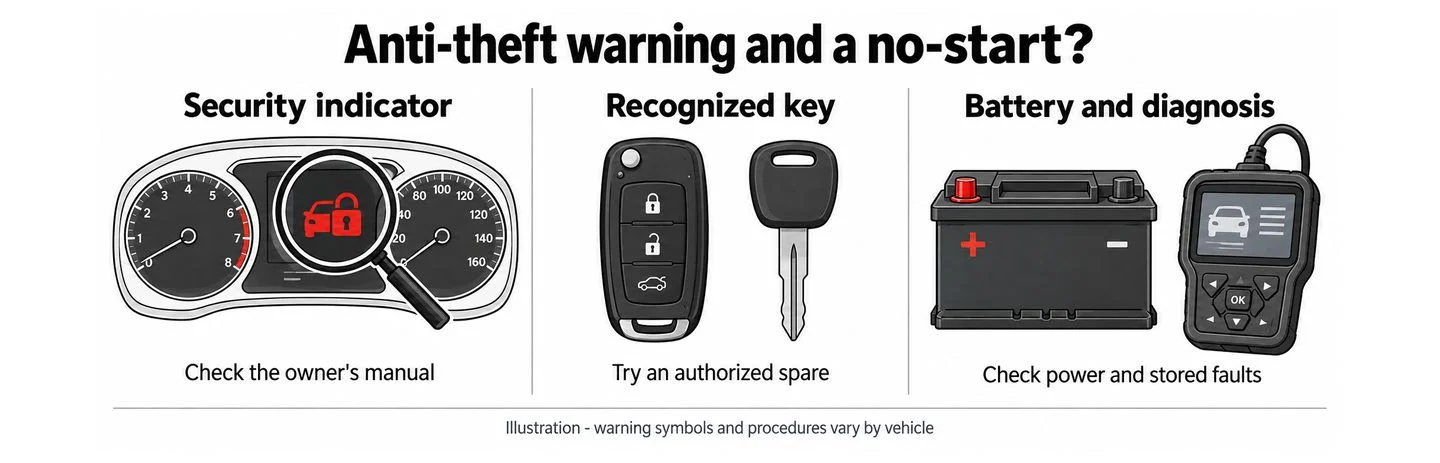
You turn the key and nothing happens. Or the engine fires for a second and dies, like someone pulled the plug. The dash lights work, the battery seems fine, and there's a small light shaped like a key or a padlock that won't stop flashing.
If that sounds familiar, your car's anti-theft system may be involved. Some of the causes are simple enough to rule out yourself in a few minutes, and that's where this guide starts.
Many vehicles on the road have an engine immobilizer. Your key or key fob contains a small transponder chip, and the car checks that chip's code before it allows the engine to run. If the code doesn't match what the car expects, the computer can block fuel, spark, or the starter circuit, depending on the make and model.
One detail matters a lot here: on most cars the transponder chip itself is passive. It has no battery and is powered by the car's reader when you try to start. The coin battery inside your key fob runs the remote lock and unlock buttons and, on push-button start cars, the wireless signal the car uses to detect the fob. A dead fob battery is a different problem from a dead transponder, and they get confused constantly.
The reader's location also varies. On key-start cars it typically sits around the ignition cylinder. On push-button cars there is a backup detection spot, often the start button itself, a pocket in the center console, a cup holder, or a slot on the steering column. Ford, Chevrolet, and Toyota all publish versions of this backup procedure, and each one points you to your owner's manual for the exact location on your model.
If a previous owner added an aftermarket alarm or remote start, that's a separate system with its own controls, and its own ways of going wrong.
None of these prove the anti-theft system is the culprit. They're clues worth writing down before you dig deeper:
One thing not to assume: an engine that cranks normally has not ruled the immobilizer out. Many systems let the starter spin while quietly blocking fuel or spark, so cranking tells you less than you'd think.
Search this problem and you'll find plenty of reset sequences. Some are real procedures, but each applies to a specific set of makes and years. There is no universal reset. Following the wrong sequence usually costs you half an hour with a car that still won't start, so start with the manual for your exact vehicle.
The security light is easy to notice, so anti-theft systems get blamed for a lot of no-start problems they didn't cause. A few honest contrasts:
If none of the checks above change anything, a broader no-start troubleshooting guide will help you narrow it down.
If the simple checks don't get you running, the next step is reading what the car's computers recorded. A mechanic with a capable scan tool can pull immobilizer and body-module codes and see whether the car is recognizing your key. What happens after that depends on the fault. Some security-system work, especially key programming, requires security access, proof of ownership, and on certain brands, dealer-level tools or a qualified automotive locksmith. Anyone who programs keys for your car should verify it's yours.
Instant Car Fix offers mobile no-start diagnosis at your home or office, and the mechanic can tell you on site whether the problem is something that can be handled there or needs a locksmith or dealer. Same-day appointments are often available depending on your area and the day's schedule.


Sometimes, yes. Low voltage can interrupt communication between modules, and some cars need a relearn procedure after the battery is disconnected or replaced. If your battery keeps dying, fix that first.
Occasionally. If the trigger was temporary, like a low battery that's since been charged, some cars return to normal on their own. Others stay locked out until a manual relearn or reprogramming is done.
We don't recommend it. The immobilizer exists to keep your car from being stolen, and a bypass leaves it unprotected. Bypass kits also introduce wiring changes that can cause their own problems down the road.
Not always, but be ready for the possibility. Some security work can be handled by a mobile mechanic or a qualified automotive locksmith. Certain brands and certain key-programming jobs genuinely require dealer tools and security access, and a proper diagnosis is how you find out which one your car needs.
Instant Car Fix offers mobile no-start diagnosis at your home or office. The mechanic can tell you on site whether the problem can be handled there or needs a locksmith or dealer. Same-day appointments are often available depending on your area and the day's schedule.

Sergio fixed the car really fast and it drives and sounds much better than before. I would recommend having him fix any car again


Somewhat hesitant as it was a website I had never used before, but the mechanic came out. Performed the service, quick and efficient and good to go.

Although there was some confusion about our appointment window. I found customer service to be extremely helpful. My only suggestion would be that there is the opportunity to chat with the actual mechanic. I was arranging service for my father, who’s out of town and had some memory issues, so it would’ve made it much easier to coordinate and understand if I could chat with the mechanic.

These guys show up and do great work. I've had a couple issues with my vehicle and Instant Car Fix helped me fully diagnose and repair all issues with relative ease. Great customer service and great communication. Thanks guys!

Was very helpful and went out of his way to run multiple Diagnostics to find the issue, got the job done very fast and put me back on the road.

Needed a subframe cradle replaced for a 2014 Dodge Charger 5.7. Left the mechanic this morning. I had to go to work. Got back from work. Checked on my vehicle turned it on, and no more engine vibration inside my cabin. Job well done. Thank you.

Mr. Jimmy is great and very good with his work. I would recommend him again to do the work. Thank you!

Great service! I appreciate how clear Jean Carlos explained everything and even let me know what other areas of my Jeep needed attention. I also appreciated Instant Fix following up with me to schedule my next service. 10/10 would definitely recommend

Dustin did a fantastic job getting my broken bolt out fast and efficiently. I can now continue my project. Thank you!

Sergio fixed the car really fast and it drives and sounds much better than before. I would recommend having him fix any car again
Somewhat hesitant as it was a website I had never used before, but the mechanic came out. Performed the service, quick and efficient and good to go.
Although there was some confusion about our appointment window. I found customer service to be extremely helpful. My only suggestion would be that there is the opportunity to chat with the actual mechanic. I was arranging service for my father, who’s out of town and had some memory issues, so it would’ve made it much easier to coordinate and understand if I could chat with the mechanic.
These guys show up and do great work. I've had a couple issues with my vehicle and Instant Car Fix helped me fully diagnose and repair all issues with relative ease. Great customer service and great communication. Thanks guys!
Was very helpful and went out of his way to run multiple Diagnostics to find the issue, got the job done very fast and put me back on the road.
Needed a subframe cradle replaced for a 2014 Dodge Charger 5.7. Left the mechanic this morning. I had to go to work. Got back from work. Checked on my vehicle turned it on, and no more engine vibration inside my cabin. Job well done. Thank you.
Mr. Jimmy is great and very good with his work. I would recommend him again to do the work. Thank you!
Great service! I appreciate how clear Jean Carlos explained everything and even let me know what other areas of my Jeep needed attention. I also appreciated Instant Fix following up with me to schedule my next service. 10/10 would definitely recommend
Dustin did a fantastic job getting my broken bolt out fast and efficiently. I can now continue my project. Thank you!